Tuesday, August 14, 2007

There is a certain sense of swooning nostalgia we have for small towns, especially if we didn‘t come from them. Our idyllic fascinations of places which reflect a sense of history are many times marred by the reality of what some have become. The charm we hope for are nowadays replaced by fast food chains or that big box retailer. While many towns have struggled to maintain their roots, Bisbee, AZ has retained all its antiquated charm meeting any expectations one might have and exceeding them.

Bisbee is located a brisk 90 miles south of Tucson Int’l Airport via the 10 to Route 80. The drive passes through Tombstone, a town immortalized by Wyatt Earp’s Gunfight at the O.K. Coral depicted in the film aptly titled, Tombstone. Bisbee, founded in 1880, was once a booming mine town of 20,000 people which was once considered the “the largest and most cultured city between St. Louis and San Francisco”. After a fire swept through Bisbee 1908, most of the town had to be rebuilt. Specializing in cooper, silver, gold and some turquoise Bisbee’s population had decreased exponentially even before the mine closures in 1974. What could have developed into a ghost town, although Bisbee is known for its fair share of paranormal activity, Bisbee was discovered by artist and hippies in the 70s. Drawn in by cheap rents and the turn of the century architecture, Bisbee became a burgeoning and eclectic art community that it still is today.

Rebuilt before the mass production of the automobile, Bisbee has a very walkable, European feel, while retaining its Victorian and Art Deco roots. With its cascading staircases and hilly terrain, it can sometimes be a hike. Yet with the distractions of the local street art and some of the best vintage and antique stores you will ever stepped foot in, you won’t care to notice. Apropos to conventional wisdom about most of Southern Arizona‘s blistering summer heat, Bisbee’s climate is mild year round. This generalization causes many places to shut down in the summer for lack of tourist, despite being a great escape from the desert heat.

For a population just above 6,000 people, Bisbee is also home to a diverse mix of restaurants that rival those of their big city counter parts. Ranging from the organic, locally grown fare of the High Desert Market and Café to the Gourmet cuisine of the award winning Café Roka, Bisbee holds its own when it comes to culinary delights. With an array of great places to eat and activities like Queen Mine Tour which takes you 1,000 feet into an ore mine or the Lavender Jeep tours, it is worth staying for at least a couple of days. Yet despite the many quaint bed and breakfasts, inns, or the supposedly haunted Copper Queen Hotel (which is an obvious choice to some) there is only one place to stay to truly get the full Bisbee experience. That place is the is the vintage trailer park known as The Shady Dell.

Located just a 1 1/2 from the Old Bisbee, a drive which gives an incredible view of the excavated Lavender Mine pit, The Shady Dell is a throwback to a different era. Boasting 10, mostly aluminum, mid-century trailers and a docked yacht, The Shady Dell is the closest thing to entering a time warp. Each trailer is vintage to a tee and not in a reproduced kitschy way. Each trailer features authentic period detail down from the genuine glasses and drink stirrers, to the round televisions, or the phonograph spinning records from the likes of the Rat Pack and Johnny Cash. Staying at the Shady Dell is the closest one can get to feeling what it was like in, or get chance to relive, this bygone era.

Established in 1927 as just another RV park for travelers taking Route 80, the trailers are now the destination. Many of these shrines to the open road sport their own themes. The Polynesian themed Tiki Bus can sleep 3 and features a wooden, hand carved tiki bar for all your outdoor Mai Tai needs. The 1949 Airstream, which was used in an issue of Bride’s Magazine, is made for the honeymooners. Featuring a photo album of vintage wedding pictures, this Airstream sleeps two love birds rather nicely. The Shady Dell sometimes accommodates entire wedding parties that rent out the whole park.

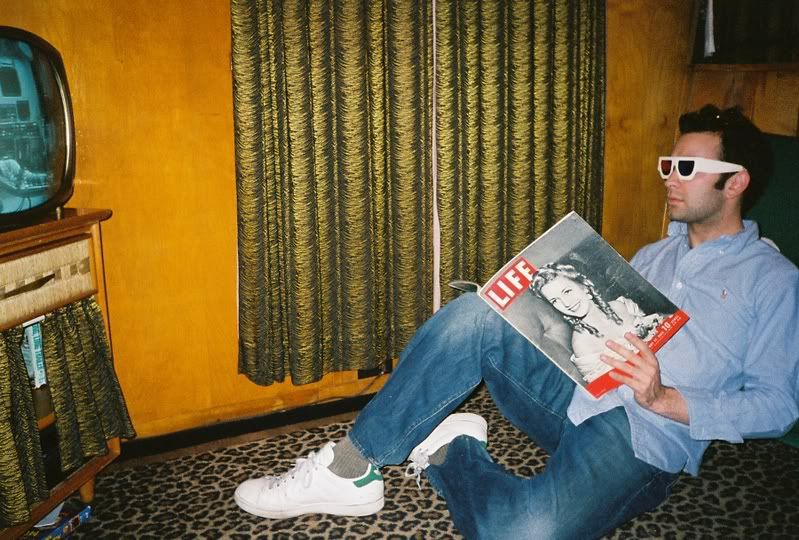
When I stayed at the Shady Dell I opted for the Royal Mansion. This aluminum trailer has an interior of rich blonde wood with cheetah carpeting to boot. The Mansion has a stocked, full kitchen with a fridge and a green leather breakfast booth, a great place to kick back and eat after grilling on one of the Shady Dell’s BBQs. Even though Bisbee has an active night life, why go out when you have your martini shaker and glasses? Relax in the living area and cozy up on the green sofa to watch a classic 3D movie on the vintage set, 3D glasses included. Or why not skim through the collection of vinyl LPs and 45s, listening to the great sounds of yore, sipping down your freshly shaken martini while reading the “latest” issue of LIFE magazine?

The crown jewel on the property has to be the Chris Craft Yacht. This docked, 38 foot beauty is made for those who have nostalgic desire for the sea but cannot cope without the aide of Dramamine. Judging by the complementary champagne in the fridge, this yacht is also meant for a romantic evening. The yacht is also equipped with a phonograph player featuring LPs from the 40’s but the galley of this ship is also adorned with nautical treasures that would make any oceanic enthusiast feel right at home. The yacht is placed away from the rest of the trailers and has the most private feel with a covered roof and a private dock with its own BBQ grill.

The 1957 Airfloat, trailer is only trailer to have its own shower but a good portion of the trailers have their own bathroom. There are large and accommodating male and female bathrooms with shower facilities on the premises.

With all wonder The Shady Dell has to offer it would not be fair to the faint of heart not to mention the fact that it is adjacent to a graveyard. This fact might be something you can cover up to your significant other if you check in at night, but if they look out that window it may cause a sleepless night. So it is best to know, or warn your guest ahead of time.

Among the many culinary treasures in Bisbee, you can’t stay at The Shady Dell without having breakfast or lunch at Dot’s Diner. Situated on the property Dot’s Diner is an authentic 1957 Valentine Diner once called “Burger Barn No. 3”. Valentine Manufacturing Co., based out of Kansas City, started out making White Castle’s but soon began making prefabricated diners which where shipped to their intended destination. This diner used to sit on the corner of Ventura and Topanga Canyon in Los Angeles’ San Fernando Valley.

The road to Bisbee was a tumultuous one for Dot’s. After being neglected for years after its closing it was discovered by the owners of the Shady Dell, moved to Bisbee via a flatbed truck, and given a loving restoration which took over 6 months. Opening in May of 97, Dot’s opened with the namesake of the cook Dot Bozeman. Although she is no longer the helm of the diner, her spirit lives on with no frills breakfast and burgers where flavor takes precedent over any form of fancy plating.

Bisbee is by no means a typical destination. It embodies a vast array of titles and histories, giving the visitor the ability to delve into both the past while also giving one the chance to lay their eyes on something that is sadly rare this day in age. A place that can constructively look to the future while retaining its character and rich history. Now what are you waiting for?

Wednesday, June 20, 2007

When reflecting on the origins of a sandwich, many times, the name reflects the city of their origin. Hamburg, Germany is know for coining the term Hamburger. Philadelphia has the Philly cheese steak. Even if it is not in the name, it is sometimes reflected in the vernacular of the language, as is evident with New Orleans’s Po’ Boy sandwich. So it may come as a surprise to some that Los Angeles is home to the French Dip Sandwich. The real problem is figuring out who exactly created it.

Philippe's the Original and Cole's P.E. Buffet both claim to have the distinction of inventing the French Dip and to this day it is still debated. The French Dip sandwich is traditionally characterized by roast beef on a roll of French Bread and served with the natural roasting juices knows as au jus. Both of these venerable institutions were established in 1908 but their stories on how they were created differ.

Philippe Mathieu, the original owner of Philippe’s, made the claim that in 1918 while making a roast beef sandwich for a policeman at his deli, he accidentally dropped the French roll into the pan with the au jus. The cop, as the yarn goes, decided to have the sandwich anyway and then came back the next day with his fellow officers for a “dipped” sandwich. The name of the sandwich itself is either derived from Mathieu’s heritage (he was a French immigrant), the bread itself, or the dubious claim that the officer’s name was French. But as Philippe’s website conveniently puts it “The answer is lost to history.”

Popularly, the French Dip sandwich is accompanied with a side of the au jus to dip the sandwich into, but at Philippe’s the two halves of the French roll are dipped once into the au jus or can be double dipped. The sandwich can be served with cheese or Philippe’s own hot mustard which they bottle and sell at the gift stand. The thinly sliced roast beef, although the staple, is not the only type of French Dip served. Turkey, ham, roast pork or leg of lamb are other delectable options. The lamb with blue cheese is considered by Esquire magazine as one of the Top 25 sandwiches in the country.

Philippe’s moved from their original location to make way for the Hollywood 101 Freeway to its current location, a block north of Union Station, in 1951. Still it has a classic feel to it that is rare this day in age where known chains or hip restaurants that are more interested in concepts than food, dominate the landscape. Philippe’s is the embodiment of no frills. Where a cup of coffee is still 9 cents, sawdust covers the floor, and communal style seating give a sense of community and family that is almost completely singular to Philippe’s in Los Angeles.

What has brought people coming back for nearly 100 years is the sandwich itself. Although admittedly small, and on first taste may not leave you breathless, the sandwich has the same effect of a great home cooked meal. Even if you have had hundreds of different French dips in your day, Philippe’s gives you the feeling that you were raised on theirs. Other people obviously feel this way too as they serve over “a million specially baked French rolls, 200,000 pounds of beef, 100,000 pounds lean eastern pork, 36,000 pounds spring lamb, [and] 37,000 pounds of baked ham” each year.

Cole’s claims to have been serving the sandwich months after it was opened by Henry Cole in 1908. Their story is that a patron asked if the chef could dip the roll into the au jus, as it was too tough on his gums - a story which may not be all that flattering to the bread itself - and the French Dip was born. Another distinction Cole’s contends to is having the very first check cashing service.

Although both Philippe’s and Cole’s were established in 1908, Cole’s opened just a few months prior to Philippe’s making Cole’s, which is designated as Historical Landmark #104, officially the oldest bar and restaurant in all of Los Angeles to be run from the same location. The location is the basement level of the Pacific Electric Building (hence the P.E.) which was the main terminal for The Pacific Electric Railway, also knows as the Red Cars. For a city known for its traffic congested highways Los Angeles was linked to Orange, Ventura, Riverside, and San Bernardino counties in what was once the worlds largest interurban electric mass transit service until its closure in 1961.

Cole’s is much more austere than its counter part. Not the family affair that Philippe’s is, Cole’s is located near Skid Row and devoid of parking so accessibility is not one of its strong points. Yet despite the fact that the harder clientele was made up of the kind of regulars who receive phone calls at the bar but this didn’t stop purveyors of the sandwich from always coming back. Entering Cole’s is not far off from entering a time warp. Almost everything from the Tiffany shades to the mahogany bar are original to the building. Like Philippe’s there is sawdust on the floor, but Cole’s is adorned with, and practically a shrine to the old Pacific Electric Railway. Some of the tables are even made from sides of the red cars.

Getting a sandwich, or just a beer at Cole’s, could also be a history lesson. Mahddi, the owner since 1979, after ringing you up on a register as old as the place itself, would give you a tour of the of the entire property. Showing the back rooms where Al Capone supposedly hung out or the walls are adorned with photos of the many films and television shows shot there, such as Mr. and Mrs. Smith, N.Y.P.D Blue, and Forrest Gump.

The French Dip at Cole’s differs most distinctly from Philippe’s because instead of presliced roast beef, the roast is hand carved and, as most who are familiar with the sandwich are used to, served with a side of au jus. Cole’s Corned Beef Dip is also a highly regarded sandwich in their oeuvre but how do they stack up? In my opinion Cole’s has the better of the two sandwiches because of the higher quality of the hand carved meats and the side of au jus. Yet although I feel it is a better tasting sandwich, Philippe’s still, for whatever reason, has a more classic home cooked taste that brings you back.

Recently the Pacific Electric Building was purchased for loft conversion in the newly gentrified area and 213 Inc., a premier night life company based in Downtown LA, acquired Cole’s in March of 2007. Cole’s is currently closed for a loving and careful restoration to revive its original glory. “We are doing some research internally about who the true ‘originator’ of the sandwich is and we are ready and willing to give Philippe’s a run their money when we reopen.” says Leann Repprecht, the project manager for 213. Although they are planning on bringing in an undisclosed “named” chef for menu creation and recipe development - Cole’s buffet items left less to be desired - they plan on staying true to the original recipe of the French Dip itself. As for when they are planning to start work and reopen the doors of the oldest continuously running business in LA, “Cole’s will be celebrating its 100th Birthday next year so we are planning for a reopen date in early 2008.”

Yet, with all the controversy over Cole’s and Philippe’s, they are not the only institutions that specialize in French Dip sandwiches. The Hat, with numerous locations through the San Gabriel Valley, and Johnnie's Pastrami, in Culver City, have both been specializing in Pastrami Dip sandwiches since the 1950s. The Hat serves an admirable Pastrami or Roast Beef Dip. While in the case of Johnnie’s, there is more to say about the nostalgia of the original 1950’s interior and signage than the dip itself.

Of all the French Dip institutions in the City of Angels, a stand in Sherman Oaks simply called The Dip is where I am most frequently drawn to. Opened in 2002, The Dip, to me, is an improvement on all the classics. The Dip serves all of the French Dip standards like roast beef, turkey, pastrami, pork and lamb which can all be served dry, dipped, double dipped or submerged and served with a side of au jus upon request. The sandwich that brings me back over and over again is the roast beef with smoked mozzarella and a side of au jus.

The Dips’ sandwiches are significantly larger and more succulent than its competitors and offer other great choices on the menu like the amazing Pot Roast Dip, which you can also fill with mashed potatoes. The Turkey Dip with mashed potatoes is like a delicious thanksgiving meal on a bun.

The Dip is also the only French Dip establishment to offer a vegetarian option that isn’t just a cheese dip. The Veggie Dip is filled with peppers, eggplant, and portabella mushrooms, for the non-carnivore.

Recently The Dip has expanded to the Hollywood and Highland Center where it neighbors Grauman’s Chinese Theatre as well as the Kodak Theatre where the Oscars are held annually. After repeated visits over the years to The Dip I was shocked, to see the owner and man behind the counter, Ken Davitian, in some very compromising situations on the big screen playing Azamat Bagatov in the hit comedy Borat. With the popularity of the film, both Dips have Borat posters that adorn the walls of his restaurants which are continuing the tradition of the French Dip as a landmark food of Los Angeles.

It may be lost in history whether it was Cole’s or Philippe’s who originated the sandwich, but when there is such a vast diversity and experience to each sandwich, who really cares?

Saturday, June 17, 2006

Phil Writes Them as He Sees Them: A Prairie Home Companion - By Robert Altman


A film by Robert Altman. There is something interesting about the kind of weight that carries. Immediately one comes to the conclusion that a film by Robert Altman means “important”. From the moment the film begins it is typical Altman. The layered multi-tracked audio, the constant movement of the camera, the improvisation from an ensemble cast. All is supposed to be well, this is as they say when any director becomes distinct (the name being followed by an “esque” or a “ian”), Altman-esque. I knew from the moment it began, and although maybe I should not admit this as it may seem unfair, that I was not going to like this picture. In retrospective I can understand why those first few moments were the beginning of the end for me.

As I said there is a certain weight that an Altman picture carries - this film not only carried all the nuances of a “typical” Altman film, it came off to me as Robert Altman doing his idea of an Altman film and not a particularly inspired one at that. I must admit some prejudices against this film before I get too deep though. Garrison Keilor and his radio shows have always been an anomaly to me. Neither funny nor keenly interesting there was always a sort of pull to it because it evokes some nostalgic quality of a by gone era of radio shows and simple entertainment. When I have attempted to listen to the show, or have been drawn into it, it always came from a place of wonder and not childhood wonder but the wonder of, who thinks this is funny? Who really loves this? People are laughing in the audience but I am not sure what is so funny about that biscuit recipe. Kellior’s script itself seems to draw attention to this many times, seemingly aware that his radio shows are not understood by people. That being said I had some high hopes for this film. I had a feeling that with Altman at the helm it would be an interesting look at the backstage workings of the end of a Ficitionalized version of Kellior’s own show.

The major problem with the film is that well over an hour of the films 105 minute length is taken up by musical performance. Not only is this demanding on the viewer but it doesn’t bring the person who isn’t a fan of Kellior’s show, or sub-par music, into a world that would be interesting tenough beyond the framework of the film. I think one important goal is to bring the viewer into the world especially if it’s not of their vested interest. I went into this film not being interested in Kellior and well let’s be honest Altman is extremely inconsistent, yet my hopes were still high. Altman seems to mistake time given to a subject (drawn out musical sequences), to actually making the experience just that, an experience. With a small amount of time allocated to actual character interaction you never have time to actually care for anything that is going on. What we do get is a dramatization of what it might be like to be at a concert your parents took you too. I say that knowing that there is a hell of a lot more “jokes” and talking in Kellior’s actual show than in this film and why so much of the running time is relegated to stale musical performances isn’t very clear to me.

For me the only real saving Grace of this film was John C. Reily and Woody Harrelson’s Lefty and Dusty. Their genuinely funny “Bad Jokes” song saves the film from being a total loss. Streep and Tomlin are stronger than the material given to them but their on screen chemistry adds some charm between songs. Hot off her undeserved Oscar nominated turn in the overrated and mildly enjoyable Sideways, Virginia Madsen gives a performance that extremely hard to watch. Her acting isn’t the only problem with the character. Altman has now set himself up to where weird things almost become clichés in his films, you expect things to not end up how you would think, yet in turn it ends up being just as predictable of a formula as a typical Hollywood blockbuster. Now you knew it was coming, I honestly wanted to see her do good in this film but the moment you see Lindsay Lohan on screen it is immediately apparent she is out of place. Now to her credit she is acting along side some of the most talented people working in film today but that being said, I was always aware of her being aware of herself. There wasn’t a moment in the film where I didn’t feel her acting. Even her just walking into frame I was taken out of the film.

With all this said though, this film is not awful by any means. The film had a lot of potential and that is obvious from the amount interest the film was garnering before it’s release. This film to me is most comparable to his supposed masterpiece, Nashville. I always thought Nashville was kind of a mess and thought it suffered from the same issue this film does of alienating an audience that may not enjoy the kind of music in the film and making the majority of the film the music itself. Yet once I fell in love with films like M*A*S*H*, Brewster McCloud, Secret Honor, and others I felt that I should revisit Nashville, as I did see it when I was 17, thinking I may have missed something in my intial viewing. Yet watching A Prairie Home Companion reminded me of that experience and although Nashville is obviously a better film, it helped reaffirm my feelings toward Nashville and made me remember what I disliked about it in the first place. Altman does not fail in showing us this world and there is some interesting subtext about corporate control and America's lack of respect for institutions and history, but he does fail to bring us in and make it interesting beyond the subject matter, which carries some weight as well.

2.7 out of 5

Tuesday, April 04, 2006

The Ban List: Restaurant Chains

The Ban List: Restaurant Chains

This is only the beginning. Without being overly political this is more, if anything, about exercising our rights as Americans (see how that shit’s capitalized). As more and more strip malls and developments pop up, the more one might notice the homogeneous landscape of our neighborhoods. The same restaurants and stores popping up on every street corner. We have compiled a list of restaurants to bring attention, not only to the overabundance of these particular restaurants, but to make the point that, unless we only want to go to only these places, we have to make the choice, as people, to eat “outside the box” so to speak. We have the choice to eat anywhere, and there is a plethora of great places to eat at any corner of our great county. To make the decision to eat at any of the places below is just lazy. Banning these establishments is an attempt to bring attention to the fact that we as the consumer are what drive capitalism and the more we eat and the more we accept places like the ones listed below the more we are contributing to the shrinking of our choices as consumers. Some of these places are good, most average, and some just plain awful. One might ask, is it such a big deal? Well, yes. We are too focused on making the easy decisions in life and that attitude trickles into all of our decisions. It more about the importance of making choices and having choice and we should make the choice to not spend above average prices for average food. Empower yourself against blah food. We are also open to suggestions to add to the list and it would be great to make suggestions of great places that people can try instead of going to the places we seem to not be able to escape. We are asking for a ban of these establishments for the blight on the landscape, their average food which cost generally more than other better restaurants, and to diversify our choices in the market place.

- Olive Garden
- Outback
- Chili’s
- Elephant Bar
- Islands
- California Pizza Kitchen
- BJ’s
- El Torito
- Cheesecake Factory
- Macaroni Grill
- Buca de Bepo
- Maggiano’s
- Applebee’s
- TGIF Fridays
- Ruby Tuesdays
- Red Robin
- P.F. Chang’s
- Marie Calender’s
- Ruby’s
- Yard House
- Benihana
- Cold Stone
- Hooters
- Rock Bottom
- BubbaGump Shrimp Co.
- Claim Jumper
- Black Angus
- Mimi’s Café

Unspoken (if it even needs to be mentioned you are beyond help):
- Tony Roma’s (sorry Nick and Jessica)
- Chevy’s
- Coco’s (except if your over 60)
- Sizzler
- Red Lobster

Tuesday, January 31, 2006

Phil Writes Them as He Sees Them: This Divided State by Steven Greenstreet

Documentaries, by nature, are uniformly good. Now I must say that not all of them are but as of late the output of great documentaries have been constant and consistent. In regards to my thesis of sorts, I say they are uniformly good specifically because their directive and purpose is information. Unlike narrative film (which of course documentary filmmaking does adapt to the structure of narrative film or at least the good ones) the documentary is a more human form of filmmaking. I say all this because of late there really hasn't been a documentary that I haven't enjoyed which means either I have a bias that I am not completely aware of, there is a certain strength that cannot be ignored in the format, or this is just the "Golden Age" of the documentary. Enron: The Smartest Guys in the Room, Grizzly Man, Murderball, Guerrilla: The Taking of Patty Hearst, The Fog of War, Tarnation, Tell Them Who You Are, The Aristocrats, The Corporation, Overnight, Inside Deep Throat, and the best and most recent Why We Fight, to literally name a few, are all, despite having flaws of their own, stellar documentaries but more importantly, great films.

This Divided State proves that the documentary, even in it's most simplistic form is not only the most empowering format but is easily the most provocative.

Viewing myself as a filmmaker, a statement that is based more on a mindset then an actual output, the idea of the documentary is powerful because it is the ultimate achievement of any filmmaker to make a difference beyond the film. This Divided State follows the controversy surrounding the student body of a Mormon college in Utah decision to invite documentary filmmaker Michael Moore to speak at their school. Steve Greenstreet immediately involves us in a cast of "characters" who not only move the story forward but also are effective in causing the viewer to become emotionally involved inspite of whatever their view point is.

The most compelling moments in the film are the segments which involve Kay Anderson, a conservative who is trying to uphold the traditional morals of "Family City" USA and the speaking engagement of conservative talking head Sean Hannity. Both of these men, more specifically Sean Hannity, come off as simple minded and small focused with their talking points with nothing but their own words. Sean Hannity's speech is a 20 minute portion of the film that represents a lack of general understanding of the human condition or good political discourse. He is able to make his liberal opponents look dumb by using their nervousness against them but also ends up looking incredible cheap in the process. His use of the world "liberal" as a slur is nothing but propaganda against a huge demographic of people and the simplicity of his views are encompassed by these statements. With all of the controversy Moore's visit congers up the most disappointing part of the build up is Moore himself who comes off as a lighter more friendly version of Hannity who although his approach and ideology come off as stronger and less of an attack, all the fuss about his visit is diminished by the fact that he is nothing more than the democratic version of Hannity.

The film is extremely well constructed and the use of Godspeed You Black Emperor! is a nice touch as well. The film is a great representation of the political divide in this county and how people who know their agenda cannot stand on it's own are afraid of outside influences corrupting their ideology with a possible truth. The funny thing is, is that Moore did nothing but speak to his base, although he did make a better attempt at reaching out as he is more charming and funny than Hannity, he made no attempt to just simply explain the facts and cared more about his agenda, which fair enough that this doc took place during the time of the upcoming Kerry/Bush election, but preaching to the choir is just that.

The fight by local conservative Kay Richardson to keep Moore out was a stronger representation of the insecurities of his views then it was the danger Moore poses. Moore's speech itself was really nothing that could sway anyone who has their heart set in what they feel is the right place.

The film has many strong moments and few very cute superfluous ones like interviews with Darth Vader and Storm Troopers. Oddly enough the Storm Troopers do not follow the allegiance of their Master Vader who thinks Moore would be a great asset to the Dark Side. To the contrary the troopers think he is un-American and think he is doing a disservice to the country. Yet I was under the impression they were all clones, not having made it through Episode II I can't be for certain what went on but I was shocked to say the least that they had starkly different views.

I give this one 3.9 out of 5 stars.

Phil Writes Them as He Sees Them: The Introduction

As a sort of, avid, filmgoer I find myself constantly having insightful dialogue - in my head - about my feelings towards almost every film I see. Sometimes though, in the case of something like Merian C. Cooper and Ernest B. Schoedsack's (of King Kong fame) The Most Dangerous Game, a film adaptation of the short story you have most likely read in your high school classes, I gained nothing from watching it, but also lost nothing. I felt completely neutral toward it, and it was nothing more than a check on my Criterion Collection check list, but that in it's own right is a reaction. So in this new section, by the way is the only section thus far, I will review a film, as I see it, whether it is new, old, or even relevant. This of course is presumably exciting to no one in particular but I hope that the insights will help incite (see how I did that) decisions or cause a certain discourse on your own belief of certain films. I will attempt to not revisit films unless I find it important or something new is revealed through the act of rewatching, I also plan on tackling all mediums at one point but my diligence only goes so far.

Friday, November 11, 2005

One might say...

This is just a test, and a welcome of sorts to the Philogg. Although it is spelled as shown "philogg" I would like it to be pronounced as "flog" by the guest and predetermined fans of my, being Phil Donohue's own personal, "blog". Which is not only hip, but in, and I must give credence to the world of the blog as well as my own voice. Until my first post, await in silence.

- philip daniel donohue 11/11/05